Compound Interest: The Eighth Wonder of the World
How compound interest works, with worked examples: why time matters most, how compounding frequency, fees, inflation and taxes affect growth, and why it works against you on debt.
- 6 min read
- Updated September 26, 2026
- By Ahmed Raza
Key takeaways
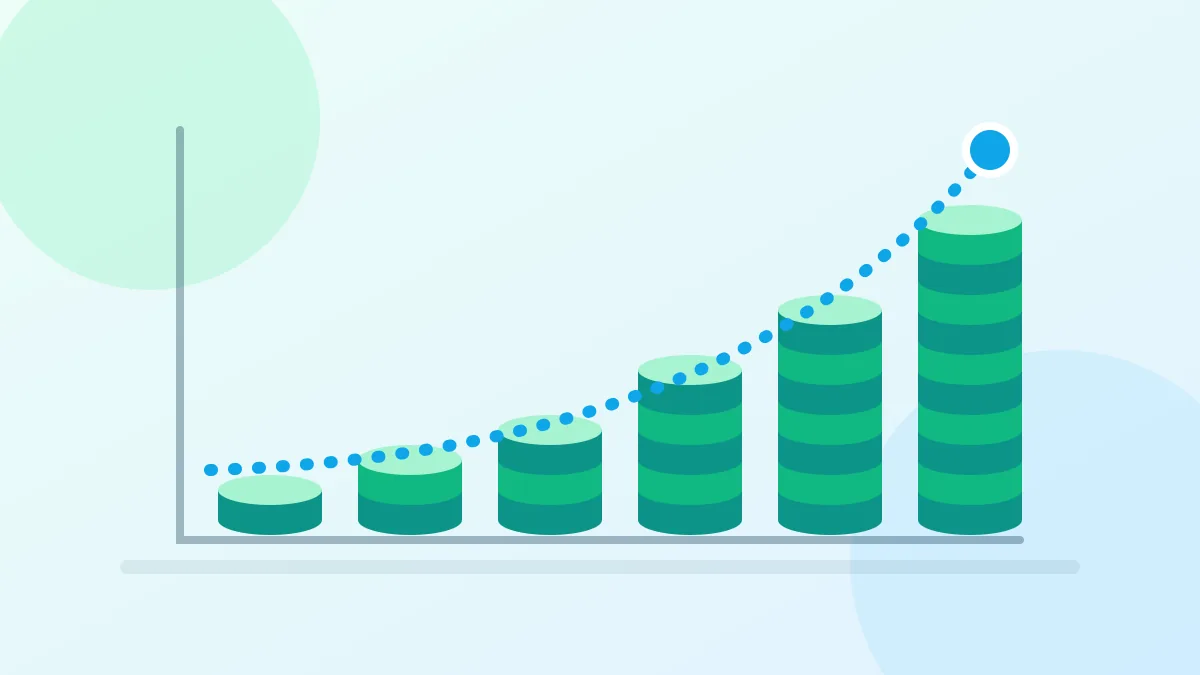
- Compound interest earns interest on past interest, so growth speeds up over time.
- Time is the biggest lever: starting ten years earlier can beat doubling your contributions.
- Compare accounts on the effective yearly rate (APY or AER), not the headline rate.
- Fees, inflation and taxes all compound too, and cutting them is as valuable as finding a higher rate.
- On debt, compounding works against you, so paying down high-interest balances comes first.
On this page
Compound interest is often called "the eighth wonder of the world", and the line is usually credited to Albert Einstein. There's no reliable record that he ever said it, so treat the quote as folklore. The idea behind it is real, though, and worth understanding properly, because it shapes how savings grow, how investments grow and how debts get out of hand.
This guide explains how compounding works, runs through worked examples you can check yourself, and covers the things that quietly slow it down. You can try your own numbers in the Compound Interest Calculator as you read.
Simple interest vs compound interest
With simple interest, you earn interest only on the money you originally put in. With compound interest, the interest you've already earned is added to the balance, and from then on it earns interest too.
Take $10,000 earning 5% a year. In the first year both methods pay $500. In the second year, simple interest pays another $500, while compound interest pays $525, because it's now working on $10,500. The gap is small at first and grows every year:
| After | Simple interest (5%) | Compound interest (5%, yearly) |
|---|---|---|
| 20 years | $20,000.00 | $26,532.98 |
| 30 years | $25,000.00 | $43,219.42 |
By year 20, the compounded balance is earning about $1,263 of interest a year on the same original $10,000. That growing annual amount is the whole story of compounding: the interest itself starts earning.
The formula
For a single deposit, the balance after compounding is:
A = P × (1 + r ÷ n)n × t
- A is the final amount
- P is the starting amount (the principal)
- r is the annual interest rate as a decimal (5% = 0.05)
- n is how many times a year interest is added (12 for monthly)
- t is the number of years
For example, $5,000 at 4% compounded monthly for 10 years is 5,000 × (1 + 0.04 ÷ 12)120 = $7,454.16. You don't need to do this by hand, but knowing what goes into the formula makes it easier to spot when a projection looks too good to be true.
Why time matters more than anything else
Because growth builds on itself, the number of years usually matters more than the rate or the amount. A handy shortcut is the rule of 72: divide 72 by the annual rate to get a rough number of years for money to double. At 6% that's about 12 years (the exact figure is 11.9). At 9% it's about 8 years (exactly 8.04). At 3% it's about 24 years (exactly 23.45). It's an approximation that is most accurate for moderate rates, but it's a quick way to sense-check a claim.
Here's what that means for regular saving. Two people each earn 7% a year, compounded monthly, with each payment made at the end of the month:
- Person A invests $100 a month for 40 years, from age 25 to 65, and pays in $48,000 in total. They finish with about $262,500.
- Person B waits until 35 and invests twice as much, $200 a month for 30 years, paying in $72,000. They finish with about $244,000.
Person B pays in $24,000 more and still ends up about $18,500 behind. The extra ten years do more work than doubling the monthly amount. If Person B had kept to $100 a month, they'd have finished with about $122,000, less than half of Person A's total.
None of this means it's too late to start. It means that whenever you start, the early years of saving do a disproportionate share of the work, so it pays not to put it off.
How often interest is added
Interest can be added yearly, quarterly, monthly or daily. The more often it's added, the sooner it starts earning interest of its own. Here is $10,000 at 5% for 10 years:
| Compounding | Balance after 10 years | Effective yearly rate |
|---|---|---|
| Yearly | $16,288.95 | 5.00% |
| Quarterly | $16,436.19 | 5.09% |
| Monthly | $16,470.09 | 5.12% |
| Daily | $16,486.65 | 5.13% |
Frequency helps, but the returns shrink quickly: going from monthly to daily adds less than $17 here. That's why comparing accounts on the effective yearly rate is the fair test. Banks show it under different names: APY (annual percentage yield) in the US and AER (annual equivalent rate) in the UK, while other lenders and banks may simply call it the effective annual rate. A higher headline rate compounded yearly can beat a slightly lower one compounded daily.
What slows compounding down
Fees
Fees compound too, in the wrong direction. $10,000 growing at 7% a year for 30 years reaches $76,122.55. Take a 1% annual fee off that return, leaving 6%, and the result is $57,434.91. That's $18,687.64 less, or about a quarter of the final balance, lost to a fee that sounds small. When you compare funds, the ongoing charge deserves as much attention as past performance.
Inflation
A balance that grows by 7% a year while prices rise by 3% a year is only gaining about 3.9% a year in real purchasing power (1.07 ÷ 1.03 − 1 ≈ 3.88%). Cash savings that earn less than inflation are shrinking in real terms, even though the number on the statement goes up. The Inflation Calculator shows what a future amount is worth in today's money.
Taxes
Tax on interest, dividends or gains each year takes money out of the balance before it can compound. That's why tax-advantaged accounts matter, but they don't all work the same way, and the difference between tax-deferred and tax-free is important:
- US: in a traditional 401(k) or IRA, growth is tax-deferred. You don't pay tax on it each year, but withdrawals are taxed as income. In a Roth 401(k) or Roth IRA you contribute money that has already been taxed, and qualified withdrawals are tax-free.
- Canada: an RRSP is tax-deferred, so withdrawals are taxed as income. Growth and withdrawals in a TFSA are tax-free.
- UK: there's no tax on interest, dividends or gains inside an ISA, including when you take money out. Pension growth isn't taxed, but most pension withdrawals are taxed as income, usually after a tax-free portion of up to a quarter (subject to limits).
- Australia: investment earnings inside super are taxed at a concessional rate, generally up to 15% while you're building the balance, rather than at your personal rate.
Contribution limits, eligibility and withdrawal rules differ between these accounts and change over time, so check the current rules with the IRS, CRA, HMRC or ATO, or ask a qualified adviser, before choosing one.
Compounding works against you on debt
The same math that grows savings also grows unpaid balances. A credit card charging 24% a year, with interest added monthly, costs about 26.8% a year in effective terms. If $5,000 were left untouched on that card, with no payments and no fees, it would grow to about $6,341 after one year and about $10,199 after three. Real card balances also change with minimum payments and fees, and some cards add interest daily, but the direction is the same. That's why paying off high-interest debt can beat many investments: every dollar repaid stops compounding against you.
Putting it to use
- Use the Compound Interest Calculator to see how a single amount grows at different rates and compounding frequencies.
- Use the SIP Calculator to see what a fixed monthly investment could add up to.
- Try a cautious rate as well as an optimistic one. Investment returns vary from year to year, and a fixed-rate projection is a guide, not a promise.
The examples in this article use fixed rates to show how the math works. They are illustrations, not predictions or financial advice.
General information, not financial advice.Read the disclaimer
More guides
 Investment7 min read
How to Track Mutual Fund Performance: Benchmarks, Ratios & Metrics
How to judge a fund's performance: benchmarks, total return, fees, volatility, drawdown, the Sharpe ratio, alpha and beta, with worked examples. For mutual funds, unit trusts, OEICs and managed funds.
Use with: Mutual Fund Return calculator Business5 min read
Markup vs Margin: Why a 50% Markup Is Only a 33% Margin
Markup and margin use the same profit but divide it by different numbers. See the formulas, a conversion table, pricing to a target margin and the mistakes that quietly cost sellers money.
Use with: Markup calculator